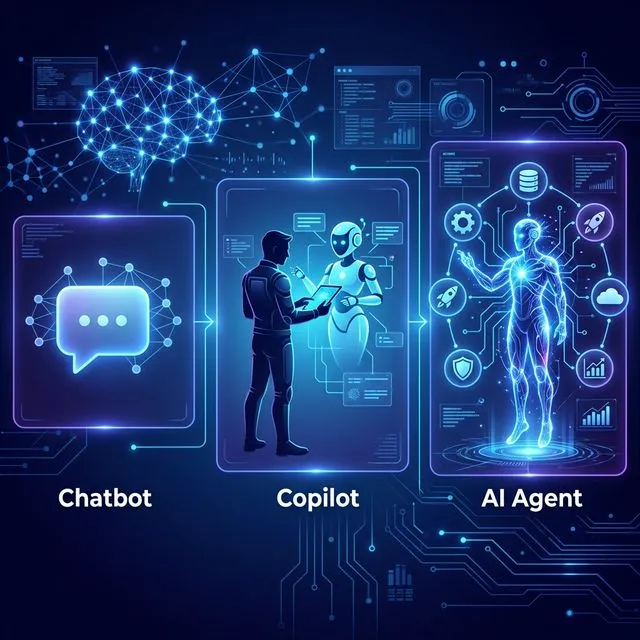
Chatbot vs. AI Agent vs. Copilot: What Is the Difference?
Who Holds the Steering Wheel?
At its core, the difference between the three systems comes down to a single question: Who controls the process?
- A chatbot steers the conversation
- A copilot helps the human with their work
- An AI agent steers the entire workflow independently
That sounds abstract. In practice, it means the difference between a system that reacts to FAQ keywords, an intelligent assistant that makes suggestions — and an autonomous colleague that solves problems.
The Three Models in Detail
Chatbot: The Conversation Manager
Chatbots are the first generation of automated customer communication. They’ve been in broad use since around 2016 and, in their classic form, follow rigid rules or decision trees.
How a chatbot works:
- Customer sends a message
- Bot recognizes keywords or intents
- Bot delivers a pre-written response
- If unrecognized: handoff to a human
Strengths:
- Low implementation cost
- Quick to deploy (often within days)
- Reliable for simple, recurring questions
- Good results for FAQs and business hours
Weaknesses:
- Only understands predefined patterns
- No real language comprehension
- Cannot take action — only respond
- Frustrating for complex inquiries
- No awareness of customer context
Modern chatbots (2025-2026) are increasingly enhanced with LLMs, gaining sophisticated language understanding. But their architecture — reacting to input, no independent action — remains reactive.
Copilot: The Assistant
Copilots became widely known from 2023 through Microsoft 365 Copilot and GitHub Copilot. They work within an existing application and support the human user in their work.
How a copilot works:
- Human works in a tool (email, CRM, IDE)
- Copilot analyzes the context of the current task
- Copilot suggests an action (draft response, code suggestion, summary)
- Human reviews, corrects, and confirms
Strengths:
- Significantly boosts individual employee productivity
- Deep integration into existing tools (Office, Outlook, Teams)
- Learns from the application context
- Reduces repetitive work
- Human retains full control
Weaknesses:
- Doesn’t act independently — waits for human confirmation
- Cannot execute cross-system workflows
- No 24/7 operation without humans
- Dependent on the quality of human input
- Only scales with headcount
The copilot is like a brilliant intern: it delivers great preliminary work, but someone needs to make the final decision and press the button.
AI Agent: The Autonomous Colleague
AI agents are the third and most advanced stage to date. They operate independently, pursue goals, and execute actions — across system boundaries and without human confirmation for routine tasks.
How an AI agent works:
- Inquiry arrives (WhatsApp, email, voice)
- Agent understands the context (customer, history, sentiment)
- Agent creates an action plan
- Agent accesses tools (CRM, billing API, knowledge base)
- Agent executes actions (close ticket, correct invoice, book appointment)
- Agent reflects on the result
- Agent responds to the customer and documents the case
Strengths:
- Fully autonomous for routine tasks
- Available 24/7, infinitely scalable
- Acts across system boundaries (CRM + billing + calendar)
- Continuously learns from interactions
- Intelligently escalates complex cases
Weaknesses:
- Higher implementation costs than chatbots
- Requires clean data infrastructure (CRM, APIs)
- Must be carefully configured (define action boundaries)
- Not suitable for highly sensitive decisions without human review
The AI agent is like an experienced case worker with access to all systems: it handles the case from start to finish — and only calls the supervisor when truly necessary.
The Direct Comparison
| Criterion | Chatbot | Copilot | AI Agent |
|---|---|---|---|
| Autonomy | Low | Medium | High |
| Action capability | Responses only | Suggestions | Real actions |
| Context understanding | Keywords | Application context | Full 360° context |
| System integration | Minimal | Within one app | Cross-system |
| Learning capability | None | Limited | Continuous |
| 24/7 without humans | Yes (limited) | No | Yes (fully) |
| Scalability | High | Limited by headcount | Unlimited |
| Use case | FAQ, simple questions | Productivity boost | End-to-end processes |
| Cost | Low | Medium (per user) | Medium-High (per platform) |
| Implementation time | Days | Weeks | 2-6 weeks |
Practical Example: Same Inquiry, Three Different Outcomes
Customer via WhatsApp: “I’d like to reschedule my appointment next Tuesday.”
Chatbot response:
“You can change appointments at appointments.company.com or call us at 0800-123456.”
Result: Customer must take action themselves. Possible dropout.
Copilot suggestion (to the employee):
“Customer (Max Mueller, appointment: Tue. March 25, 2:00 PM) wants to reschedule. Next available slots: Wed. March 26, 10:00 AM, Thu. March 27, 3:00 PM. Suggested response: ‘Happy to help! How about Wednesday at 10:00 AM or Thursday at 3:00 PM?’”
Result: Employee must review, confirm, and send. ~2-5 minutes wait time for the customer.
AI agent action:
“Hello Mr. Mueller! I found your appointment on Tuesday, March 25 at 2:00 PM. The next available slots would be Wednesday, March 26 at 10:00 AM or Thursday, March 27 at 3:00 PM — which works better for you?”
[Customer responds: “Wednesday please”]
“Perfect! I’ve rescheduled your appointment to Wednesday, March 26 at 10:00 AM. You’ll receive an updated confirmation via email shortly. Is there anything else I can help you with?”
Result: Appointment rescheduled in 30 seconds. Without human intervention.
When Each Model Fits
Choose a chatbot when:
- Budget is very limited
- Only simple FAQ coverage is needed
- Little system integration is possible
- Fast implementation is the priority
Choose a copilot when:
- Employee productivity is the main goal
- Strong existing tool usage (Microsoft 365, Salesforce)
- Human decision-making is needed for every case
- Internal workflows need optimization
Choose an AI agent when:
- Customer inquiries should be resolved autonomously
- 24/7 availability without proportional staffing is desired
- Cross-system actions are needed (CRM, billing, calendar)
- Scaling without proportional headcount growth is the goal
- Response times under 1 minute are targeted
The Trend Is Clear
Gartner predicts that 40% of all enterprise applications will contain task-specific AI agents by end of 2026. The boundaries between the three categories are increasingly blurring — chatbots are getting smarter, copilots more capable, agents more empathetic.
But the central question remains: Do you want a system that responds — one that suggests — or one that acts?
How SolvraONE Unifies All Three Stages
SolvraONE builds on a full AI agent architecture — with the flexibility to also function as an intelligent chatbot or as a copilot for your team:
- Agent mode: Fully autonomous handling of customer inquiries via WhatsApp, email, and voice
- Copilot mode: Supporting your team with response suggestions and context analysis
- Chat mode: Intelligent FAQ answering for simple inquiries
- Seamless escalation: Automatic switching between modes based on complexity
The result: One platform that grows with your requirements — from the first FAQ bot to a fully autonomous digital colleague.