
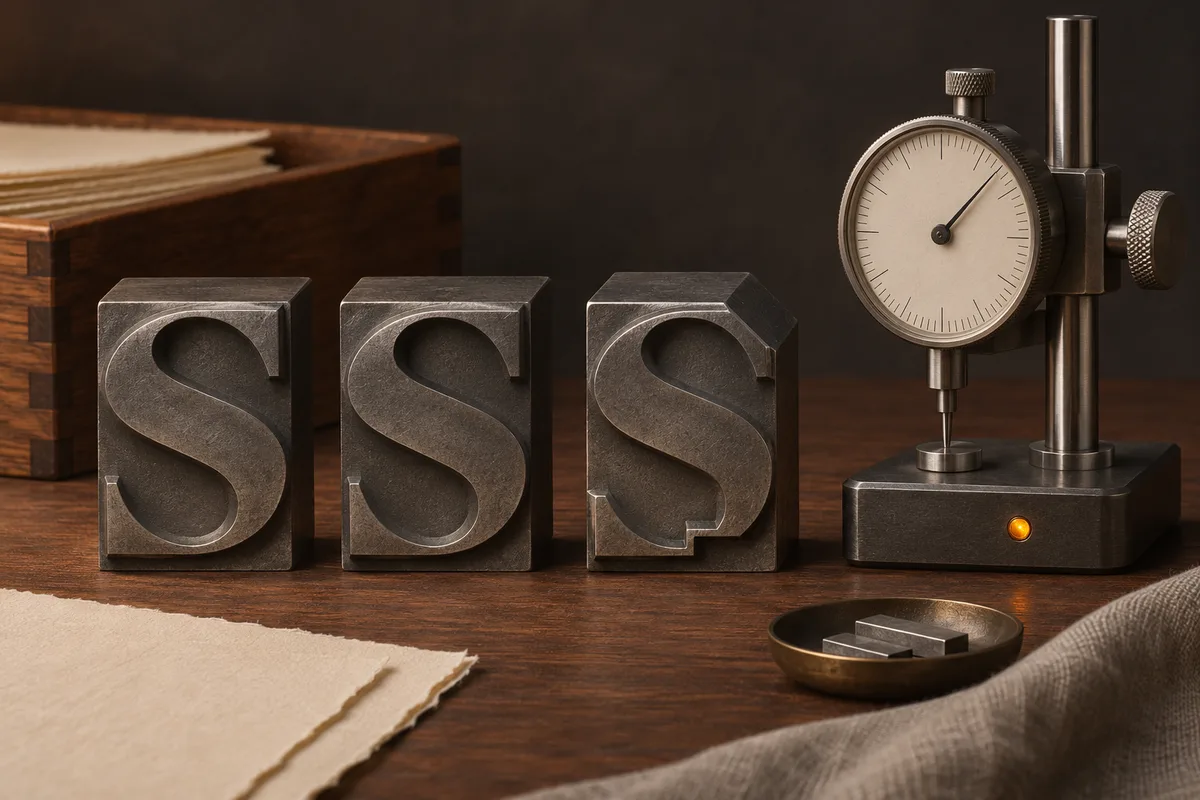
AI for drafting, fixed rules for mechanical checks: this combination helps maintain our bilingual website. A language model helps with clear writing. A fixed rule checks whether the German source file has changed since a translation was prepared.
On 22 November 2026, we called the existing source-currency function in our website core with deliberately simple sample files. This insight reports that local function experiment and our present editorial reasoning. It is not an invented client story or a reconstructed historical project decision.
The question: does the translation use the current source?
German is our source language; a shared key pairs it with English. When translating, we store a short fingerprint of the complete German file. If the source file changes, the stored fingerprint no longer matches its current state.
This limited question needs neither a prompt nor a model judgement. The function compares the stored checksum with a newly calculated one. The existing implementation uses the first 16 hexadecimal characters of a SHA-256 hash. This supports editorial change detection; it is not an authenticity seal or security proof.
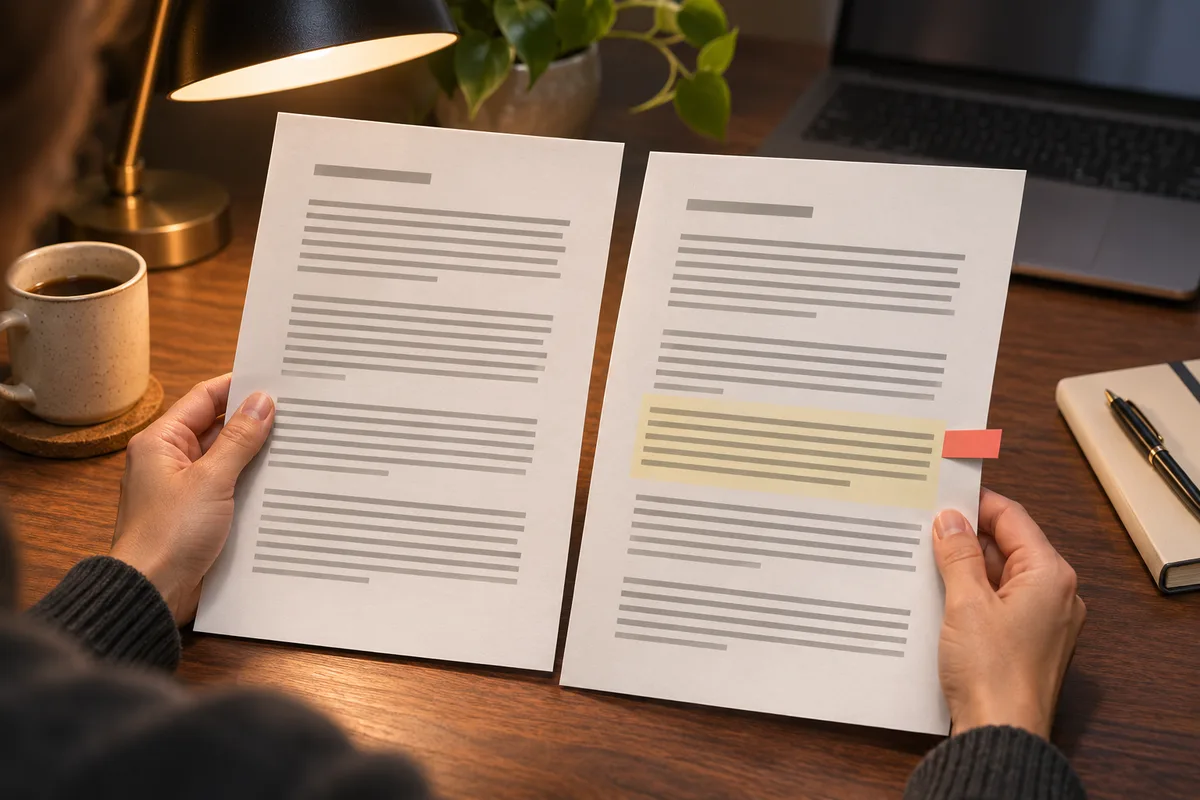
Three possible approaches and our choice
| Approach | Where it helps | For this particular question |
|---|---|---|
| Manually read both files | Check content, meaning and tone | Possible, but a repeated manual step |
| Ask a language model | Discuss wording and differences in meaning | Adds no necessary decision criterion here |
| Compare the stored source fingerprint using a fixed rule | Detect a changed source version | Already exists in our website core; chosen for this mechanical question |
We measured no time, cost or quality comparison between these approaches. The reasoning follows the narrowly defined question and existing function. Writing quality still requires editorial work.
Our local experiment with five cases
We used synthetic text only: “Die Werkstatt öffnet am Samstag.” as the German source and a matching English sentence. We called the actual sourceSha and translationState functions directly with explicit test data. No client system and no AI call were involved.
| Case | Observed status | Meaning |
|---|---|---|
| Unchanged source, matching checksum | aktuell (current) | Stored source version matches |
| Source changed to Sunday, old checksum retained | veraltet (outdated) | Translation needs another look |
| Deliberately wrong English, matching checksum | aktuell (current) | The rule does not judge meaning |
| German source missing | ohne-quelle (no source) | The counterpart is missing |
| Translation marked pending | offen (pending) | Translation is not complete |
All five expected outcomes were confirmed. The deliberately wrong English sentence was “The workshop is closed forever.” Its “current” status demonstrates the central limitation. The complete experiment record with inputs and results is available.
What the rule does and what people check
A changed date or revised paragraph can trigger another look at the English version. Because the entire source file is included, metadata changes may also change the fingerprint. This can require review even when the visible meaning has barely changed.

Accuracy, meaning and tone need separate review in both languages. Updating a checksum must not imply that a content review occurred. A shortened checksum is not a mathematically collision-free proof either.
The experiment covers these functions and five cases. It proves neither full test coverage nor the safety of every publication. Our existing website build also checks real language pairs; presentation, links and content remain further checks.
What to take into your own work
Split the task into parts: what needs drafting or interpretation, and what can be determined by an explicit condition? AI can draft an invitation while required details receive a separate check. At work, it can prepare a handover while fixed rules check required fields or allowed states.
SolvraONE combines task selection, suitable tools, practical introduction and result checking. This gives AI and conventional software useful roles in the same workflow. Complete a personal project with AI demonstrates the drafting side.
Frequently asked questions.
Does current mean the translation is correct?
No. In this function, it means only that the stored fingerprint matches the current German source. The deliberately incorrect English test sentence demonstrates the limit.
Did you test AI against conventional software?
No. We checked the existing rule-based function with synthetic cases. There was no comparative model, time or cost test.
Should we avoid AI everywhere?
No. The task decides. AI may help draft and interpret; fixed rules can check precisely defined conditions. Both can work together.
Sources.
- SolvraONE: eigener lokaler Funktionsversuch / local function experimentOwn source · As of
- Node.js: crypto.createHashVendor / primary · As of
Keep reading.

Tell us your task or goal
Describe a task or a goal. SolvraONE helps you assess whether and how AI could be useful.

Complete a personal project with AI: From idea to usable result
Complete a personal project with AI using a fictional invitation: define the brief, draft, revise and check every detail before publication.

Is AI worth it for you? We measure it.
Find useful AI tasks, introduce existing tools, train your people and measure the actual benefit.